

You open your monitor’s menu to fix the brightness and find a toggle called DCR, with no hint about what it does. DCR stands for dynamic contrast ratio, a setting that dims the backlight in dark scenes and brightens it in bright ones, all on its own. So what is DCR on a monitor good for? Leave it off for work, photo editing and competitive games, and switch it on for movies or story games only if you like the bolder look.
Below you’ll get a plain definition, a use-by-use verdict, what each brand calls the setting, and why it’s sometimes greyed out. Everything here at Best Electronics Guide comes from monitor makers’ manuals and published lab measurements, not tests of our own.
What Is DCR on a Monitor, in Plain Terms?
DCR stands for Dynamic Contrast Ratio, a setting that raises or lowers the backlight automatically based on what is on screen. Lenovo’s own glossary entry on DCR monitors describes it as a feature that “dynamically adjusts the backlight intensity to enhance the perceived contrast.”
Contrast ratio is the difference between the brightest white and the darkest black a screen can show. A 1,000:1 ratio means white is 1,000 times brighter than black. Most monitors are LCDs lit from behind, and the panel can’t block all of that light, so blacks come out a little gray. DCR tries to hide that by playing with the backlight, and every brand gives it a different name.
Menu names come from each maker’s manual or support page, confirmed in November 2026.
| Brand | What the menu calls it | Where to look |
|---|---|---|
| Samsung | Dynamic Contrast (a Picture Mode on many models) | Picture > Picture Mode |
| ASUS | ASCR (ASUS Smart Contrast Ratio) | Image > ASCR |
| Acer | ACM (Adaptive Contrast Management), shown as Adaptive Contrast on some models | Picture menu |
| LG | DFC (Digital Fine Contrast) | Settings > Picture > Picture Adjust > DFC |
| Dell | Dynamic Contrast | Display menu |
| Lenovo | DCR | OSD picture settings |
| ViewSonic | Advanced DCR | Varies by model |
How Does Dynamic Contrast Work?
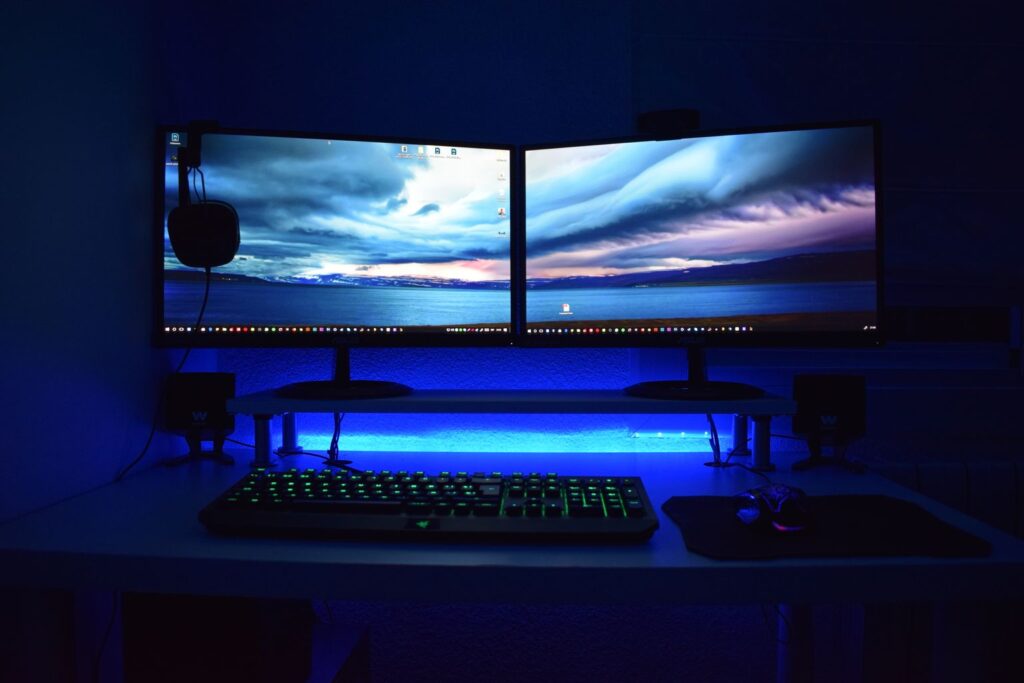
The monitor reads how bright each image on screen is and turns the whole backlight up or down to match, following every scene cut as it goes.
In Dark Scenes
When the picture goes dark, the backlight dims, so blacks look deeper and a night scene looks less washed out. The trade-off is shadow detail: dim parts of the image get pushed toward black too.
A member of the Tom’s Hardware forum who tried dynamic contrast in November 2023 reported exactly that: blacks looked deeper, but there was “zero detail in dark scenes.”
In Bright Scenes
When the picture turns bright, the backlight rises, so whites and sunny skies look punchier. On most LCD monitors there’s one backlight level for the entire screen, so a bright window in a dark room lifts the whole picture, black areas included.
That whole-screen behavior is the big difference from OLED and mini-LED. OLED switches off individual pixels and mini-LED dims small zones separately, which is why blacks look so different when you compare QNED vs OLED. Samsung treats the two as separate tools: its C49RG90 manual says Dynamic Contrast isn’t available when Local Dimming is on.
DCR vs Static Contrast Ratio: What’s the Difference?
Static contrast is measured with one fixed backlight level, while DCR compares the backlight at its highest and lowest settings, so its number is far higher.
| Measure | How it’s measured | Typical figure |
|---|---|---|
| Static contrast, IPS panel | Black and white on screen together, one backlight level | About 1,113:1 on average (RTINGS, 178 IPS monitors) |
| Static contrast, VA panel | Black and white on screen together, one backlight level | About 3,305:1 on average (RTINGS) |
| Dynamic contrast (DCR) | White at maximum backlight vs black at minimum backlight, measured separately | 20,000,000:1 to 100,000,000:1 on spec sheets (BGR, ASUS) |
The static number is what you see in a mixed scene, like a starfield. Nicholas Di Giovanni of RTINGS puts the IPS weakness plainly: “Most IPS monitors have a low contrast ratio, meaning blacks look gray next to bright highlights.” DCR can’t fix that within a single image, because it moves the whole backlight at once.
Why Do DCR Specs Say 100,000,000:1?
Those figures compare two extremes that never appear on screen together, and spec sheets rarely say how they were measured, so you can’t compare one brand’s number with another’s. ASUS says ASCR raises dynamic contrast “up to 100,000,000:1.” BGR‘s Talia Roepel, writing in May 2026, suggests looking for DCR values near 20,000,000:1, while standard ratios land closer to 2,500:1. When you shop, compare the static or native contrast figure, ideally from an independent lab review rather than the box.
Should DCR Be On or Off?
Turn it off for most everyday use, and turn it on only for movies and casual or cinematic games, if you like the look.
| What you’re doing | DCR | Why |
|---|---|---|
| Movies and TV shows | On (optional) | Deeper-looking blacks and brighter bright scenes suit dark, cinematic content |
| Single-player or cinematic games | On (optional) | Adds drama; switch it off if dark areas lose detail |
| Competitive / FPS games | Off | Constant brightness keeps enemies in shadows visible and skips any extra processing |
| Office work, reading, browsing | Off | Mostly white pages, so brightness changes are distracting |
| Photo or video editing, design | Off | You need fixed, accurate brightness and color |
| Watching HDR content on an HDR monitor | Off | Use the monitor’s HDR mode instead; DCR is often locked anyway |
Editing is where DCR causes the most regret. One student in r/ColorGrading graded a school film on a monitor with DCR on, and it looked very dark when it played in class.
Even for movies it isn’t a sure win. A Dell U2715H owner on Dell’s community forum found dark film scenes too dim to follow, and the fix was turning dynamic contrast off in the display menu.
So try it for an evening of whatever you watch most, and trust your eyes. If the screen pulses brighter and darker, or faces vanish into shadow, switch it off.
What Are the Pros and Cons of DCR?
DCR makes dark, cinematic content look bolder, but it costs you accuracy and consistent brightness.
| Pros | Cons |
|---|---|
| Blacks look deeper in dark scenes | Brightness pumps up and down on scene cuts; an r/gaming user summed it up as it “changes your brightness all the time” |
| Bright scenes look punchier | Shadow detail gets crushed toward black |
| The backlight runs lower in dark scenes, which may cut power use (Philips claims this for its SmartContrast feature) | Color and brightness are no longer accurate enough for editing |
| Works with any content, no special format needed | Adds processing; BenQ says it “adds a tiny bit of input lag” but gives no figure |
| Can lock other settings: Samsung’s C49RG90 manual disables Brightness and Smart ECO Saving+ in Dynamic Contrast mode |
Is HDR or DCR Better?
HDR is better when you have HDR content and a monitor that can really show it, while DCR is a simpler backlight trick that works on any content. HDR follows brightness instructions built into the video; DCR guesses from the picture.
| DCR | HDR | Local dimming | |
|---|---|---|---|
| What it changes | The whole backlight level | Brightness and color range, following the content’s HDR data | The backlight in separate zones |
| Needs special content? | No | Yes, HDR movies or games with HDR turned on | No |
| Whole screen or zones | Whole screen | Depends on the monitor’s backlight | Zones |
| Best for | SDR movies and casual games | HDR movies and games on a capable screen | Dark-room viewing and HDR |
The best HDR pictures come from screens that pair HDR with real local dimming. A mini-LED TV such as the Sony BRAVIA 9 dims its backlight zone by zone, so a bright moon and a black sky can share the screen. Resolution is a separate question altogether: the 4K vs 1080p choice changes sharpness, while HDR and DCR change brightness and contrast.
Is DCR on a Monitor Bad for Your Eyes?
What most people notice is comfort, not anything medical: the constant brightening and dimming can feel distracting or uncomfortable during long stretches of reading, email or spreadsheets.
If that sounds familiar, turn DCR off and set a fixed brightness that suits your room, a bit brighter by day and dimmer at night. If your eyes bother you often, whatever your settings, see an eye care professional.
How Do You Turn DCR On or Off on a Monitor?
Open the on-screen menu, go to the picture settings, and switch the dynamic contrast option on or off. On most monitors it takes four steps:
- Open the menu: Press the menu button or push the joystick, usually under the bottom edge or on the back of the monitor.
- Go to picture settings: Choose Picture, Image or Display, depending on the brand.
- Find the setting: Look for DCR, Dynamic Contrast, ASCR, ACM or DFC.
- Switch it: Set it to On or Off, then exit the menu.
Some monitors show DCR only in certain picture modes. On Samsung models where Dynamic Contrast is a Picture Mode, you turn it off by picking a different mode rather than flipping a toggle. Dell’s user guides say Dynamic Contrast gives higher contrast in the Game and Movie presets.
DCR is a setting inside the monitor, so your cable has no say in it. HDMI, DisplayPort and USB-C all work the same way.
Why Is DCR Greyed Out on My Monitor?
DCR is usually greyed out because another picture mode or feature has taken control of the backlight. The common culprits:
- A locked preset: ASUS says ASCR “isn’t configurable under Standard Mode or sRGB Mode” in its Splendid presets, and the same goes for Racing and sRGB in GameVisual.
- A preset that turns it on for you: In a Dell community reply about the S2419HGF, Dell explained that the Game 1 preset has Dynamic Contrast on by default, so the option is greyed out.
- Local dimming, HDR or eye-care modes: Samsung’s C49RG90 manual blocks Dynamic Contrast while Local Dimming is on, and blocks the Picture Mode menu with Eye Saver Mode or HDR in some modes.
- Gaming extras: An AOC owner in r/Monitors found game mode, overdrive and motion blur reduction blocked off other menu options.
The usual fix is to pick a Standard, User or Custom preset and turn off HDR, local dimming and eye-saver modes. If it stays locked, check your model’s manual.
Frequently Asked Questions
Q1:Should I activate DCR?+
Q2:Is DCR good for gaming?+
Q3:Is DCR good for FPS gaming?+
Q4:Does DCR work over HDMI?+
Q5:What is DCR on a Samsung monitor?+
Q6:What is DCR on a Lenovo monitor?+
Q7:Can DCR damage my monitor?+
Q8:What is the difference between ACR and DCR?+
The Bottom Line
Keep DCR off for work, editing and competitive games, where you want brightness that stays put and colors you can trust. Turn it on for movies or story games if the deeper blacks appeal to you, and off again once shadows start swallowing detail. When comparing monitors, judge static contrast, not the giant DCR number on the box. If a new monitor or laptop is next on your list, start with the buying help under Computers & Laptops.


2 responses